Necessary premise: in this article I might appear more extreme and hyper-rational than I actually am. I’m still a human being, unfortunately I too give in to material temptations and often find myself spending with pleasure. Enjoy!
Spending money is an Art
This is how Morgan Housel writes in the opening lines of his latest book The Art of Spending Money but, as much as I truly appreciate the author’s books and blog, I disagree with this statement.
Spending is, first of all, a habit, one of the most deep-rooted and personal habits we have, which started when we were kids, when at age we asked for the first time euros from relative to buy product .
(In my case: , , , ).
Like all daily behaviors, the way we spend says a lot about us and, although several variables are beyond our control, many people try to set rules, limits, goals and, more generally, build a narrative around money.
And since I’m convinced that personal finance contributes to a person’s mental health (cit Mr. Rip, live from 2025-05-20), I think it’s worth exploring how such behaviors arise and how much rationality lies behind them, even though, especially in Italy, there’s still a lot of fear, hypocrisy and discomfort in discussing and opening up about these topics.
Since I can’t and don’t want to conduct a comparative analysis of the Italian/global/Swiss population, I’ll simply present, break down and analyze my own beliefs and habits related to money.
Limited functions and partial derivatives
In recent years, as I’ve become increasingly independent and started earning (not enough to support myself: thanks Mom and Dad for the rent in Zurich), my relationship with money has changed a lot, influenced by people, books and family stories.
I’ve always defined myself as frugal and minimalist (we could write an entire article about the difference between these two adjectives but, for the purposes of this reflection, they’ll be treated as synonyms): I like simple and linear things, I have few clothes, I keep an essential furnishing style, I eat a diet based on few ingredients and I practice mostly “free” or very low-cost hobbies.
I have no online subscriptions, I detest luxury, and I have no expensive vices.
All perfect? Almost.
Frugality is one of the values I consider most important, but like everything else, when taken to the extreme it stops being that and becomes just a perversion.
For years, I actually viewed the act of spending as something negative, regardless of what was being bought and, although it’s a spectrum (spending for primary needs is less “negative” than wasting money on useless impulsive purchases), I’ve never liked spending money.
In mathematical terms, for me the goal has always been to minimize the spending function :
where represents our wealth, our needs and desires, the coefficients the weights (importances) we assign to each , and quantifies our outgoing cash flow.
Secondly, my second goal (especially for the future when, optimistically, will grow) has always been to nullify the partial derivative of with respect to :
that is, to prevent my spending habits from depending on my wealth and, in particular, to avoid having my expenses increase as my wealth increases.
As for the first objective, it’s a tragicomic daily struggle: is in fact lower-bounded by the necessary daily expenses () and undergoes local oscillations on occasions such as events and occasional pleasure purchases.
Regarding the second constraint, I’ve reached a good level of awareness and maturity such that an extra euros in my wallet don’t significantly change my expenses, as I can now easily identify which expenses bring me value (or not).
Although I’ve always been comfortable with this way of interpreting frugality, I’ve always done it because I found pleasure in NOT spending and saw value in that behavior, not because there was an ultimate goal or something I was saving for.
In the Balkans with Nick Magiulli
In recent months, however (fortunately), some behaviors have begun to change, especially after moving to live alone in Switzerland and after consuming, over the past few years, dozens of contents between books, articles and videos (the full list down below).
Last summer during one of the most beautiful trips of my life a road trip through Greece, Albania, Montenegro, and Bosnia, I read The Wealth Ladder, the latest book by Nick Magiulli and, even though that vacation wasn’t exactly the ideal setting to reflect and discuss money, wealth, and investments, I appreciated the content enough to include some lessons in this article.
Books, books, and more books in Albania – When the spending function was easily minimized given the cost of living in the Balkans.
Reducing the author’s theses to their simplest form, Magiulli classifies people (or households) by levels of net worth and suggests goals, spending habits, and investment strategies based on their cluster.
| Level | Net worth (EUR) | Description |
|---|---|---|
| 1 | < 10,000 | You live paycheck to paycheck, every expense counts. Priority: build an emergency fund and increase income. |
| 2 | 10,000 - 100,000 | You can do groceries without stress. You start investing small amounts and reduce debt. |
| 3 | 100,000 - 1,000,000 | You can eat out or allow yourself small luxuries. Focus: regular investing and capital growth. |
| 4 | 1,000,000 - 10,000,000 | Travel and experiences become accessible. You have financial stability and can make freer decisions. |
| 5 | 10,000,000 - 100,000,000 | You can buy your dream house and live without financial constraints. Wealth management and estate planning become key. |
| 6 | > 100,000,000 | Wealth serves to create impact, donate, influence, and build legacy. Wealth management becomes strategic and philanthropic. |
The main takeaway from this table is that, regardless of the situation one finds themselves in, any spending habit should be adapted and evaluated based on one’s wealth, to the point that Nick Magiulli suggests:
You can spend up to of your net worth each day without compromising your wealth growth.
Although such advice is too general and simplistic, the core concept is clear: below a very small threshold relative to your wealth, it’s not worth stressing too much about whether or not to make a purchase.
I actually believe that whenever money represents a good opportunity to eliminate stress or unnecessary effort from our days (by "unnecessary” I mean something that brings no benefit to anyone, not even ourselves), it makes sense to spend it without overthinking.
As you can easily guess, this advice contrasts with my initial thesis, since it no longer resolves an absolute minimization problem but imposes a different constraint:
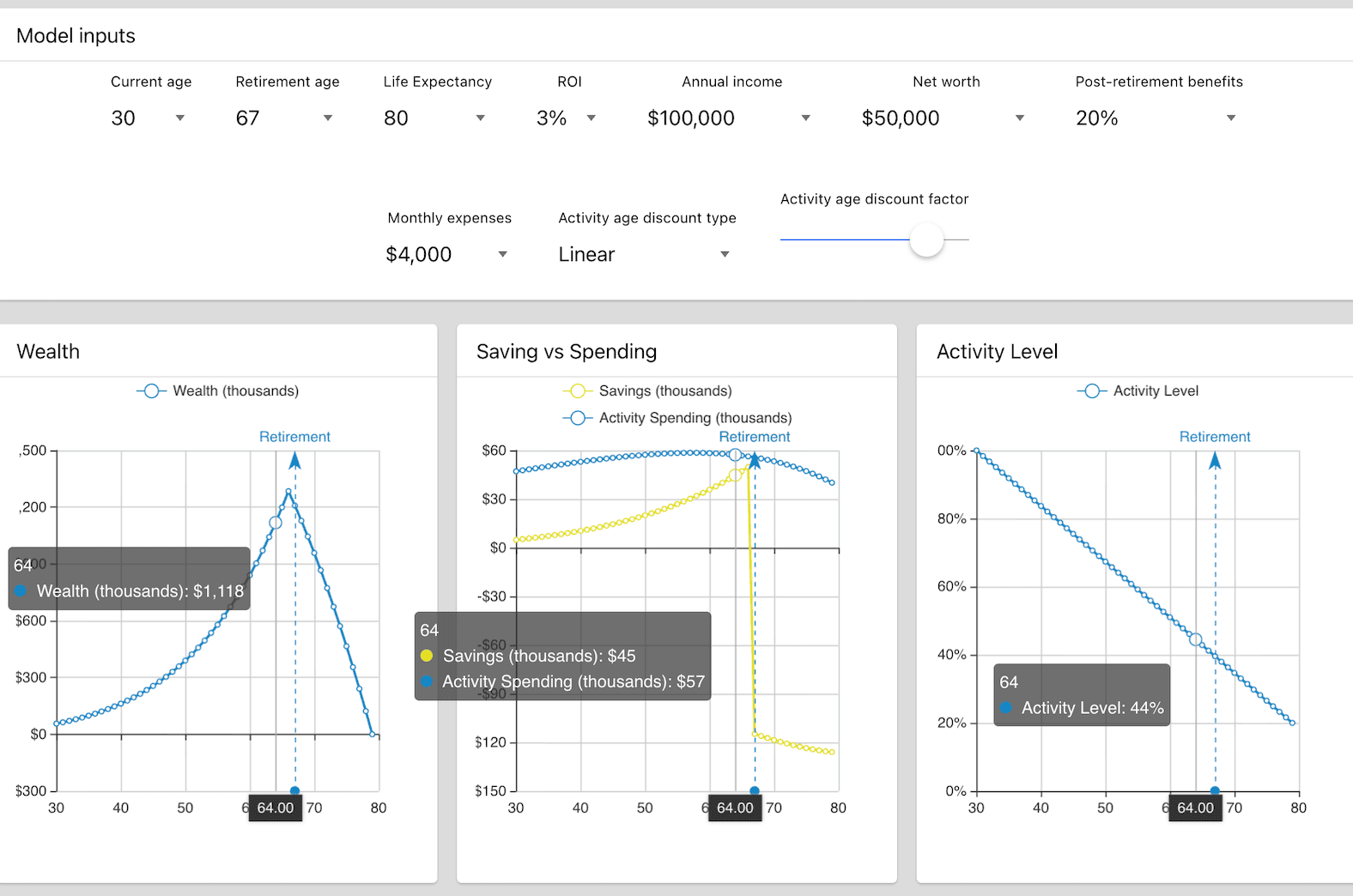
Wealth, spending, and savings simulator following Perkins' theories in Die with Zero (link at the end of the article).
Personally, I’m still in an intermediate phase: I’m lucky to have a side job that provides me with a few hundred euros a month and, as mentioned earlier, a family that covers most of my expenses.
The question I ask myself almost every day is therefore:
How should I approach every expense? Does it really make sense to minimize everything down to the last Euro/Swiss Franc?”
Unfortunately—or fortunately, depending on your point of view—for now the answer is yes.
If there’s no significant benefit, especially in the long term, I prefer to trim the expense to the last decimal digit, even though one franc more or less equals about two minutes of my work (considering my current hourly wage).
Behind this choice, in fact, there are no motivations related to the need to save or have money for something else, but rather a value-based choice to assign as much importance as possible to frugality, supported by the fact that I find "pleasure" in NOT spending money.
Note: the case just presented mainly concerns cash outflows for my “survival” and everything that happens in daily life. There are some categories of spending (health, education, some moments of social life...) for which this reasoning becomes irrelevant and stupid.
One of the best purchases (or investments) of the last year – The welcome on my first day of work.
Do you really need that bed?
An interesting counter-thesis, which I actually quite agree with, argues that only by reducing expenses to the minimum and adopting an extremely frugal lifestyle can we truly understand how little we need to be happy.
Often, in fact, we take for granted that many of the expenses we make have real value just because we’ve gotten used to making them and spending money on them. It would be enough to give them up to discover that, in reality, we need less than we think.
As fascinating as this view is to me, I'm doubtful for its social consequences.
Living in a more or less consumerist community (depending on the country or the people around us), spending is often a necessary condition to participate in community life.
Although it’s purely rational when following this theory, I don’t think it’s reasonable to push minimalism to the extremes just to understand how little we “need” to be happy, ending up living on the margins of society. However, I am convinced that, for most people and for limited periods, adopting a lifestyle aimed at eliminating the superfluous can bring greater awareness and mental clarity about the way we spend money.
At 40 you’ll be too old
If Magiulli proposed a strictly parametric way of acting, focusing on saving in
relation to one’s wealth, Bill Perkins,
author of Die With Zero, shows how and, above all,
when it makes sense to spend money.
The main thesis of the book, sometimes banal, is that the financial goal of our lives is not to maximize wealth, but rather to maximize the value we gain from meaningful experiences and, to achieve this, the timing with which we spend and save plays a fundamental role, since not all experiences are available or enjoyable at every stage of life.
Perkins introduces a spending curve and suggests modulating one’s spending function also according to age (thus adding an additional parameter to represent age): spending becomes much more reasonable when we can derive the maximum physical and emotional benefit, often in the first decades of life, which is why, especially at a young age, the last goal of our spending habits should not be saving.
According to Perkins:
for , where quantifies our expenses in experiences and is the age of maturity when we have enough awareness to spend and intentionally appreciate the experiences we pay for.
In non-mathematical terms: all else being equal, our spending on experiences should decrease with aging.
Although I totally agree that maximizing the value of our
broker account is a bullshit short-sighted idea, I’m also convinced that most
valuable experiences we can live don’t require billionaire capital and,
beyond a certain threshold, the benefits from spending more money are null.
Formally, if is the utility of an expense in experiences, for we can assume:
that is, the marginal benefits we gain after a certain spending threshold are null or, for a niche of the population, decreasing, in cases where spending more money ruins or makes an experience less authentic.
As much as I appreciate the author’s thesis, since it adopts a less rigorous approach and is more focused on maximizing our well-being, I think the initial assumption is wrong: why should spending more automatically improve our lives?
I don’t think there’s a causal link between wealth and happiness beyond a certain threshold or, in any case, even if there were, our well-being would depend on so many other variables that it would make almost irrelevant.
To close the loop, although I didn’t share a quote from Morgan Housel at the beginning, I’m convinced these concepts are masterfully expressed by the American author and investor; which is why, in addition to recommending The Psychology of Money, it feels natural to mention him again here.
“If you are rich, you have money in the bank that allows you to buy the stuff you want.
If you are wealthy, you have a level of control over what that money does to your personality, your freedom, your desires, ambitions, morals, friendships, and mental health.”
Just like minimalism and frugality, I’d love to write an entire article about the differences between rich and wealthy and expand on Morgan Housel’s theses, but for today, I’ll just define myself as wealthy much more than I am rich, hoping that what I’ve just shared can offer some thought-provoking insights and anecdotes.
For the more curious, below are some resources that have shaped my relationship with money.
- Nick Magiulli's Blog
- My favorite book about frugality and saving
- To laugh about money and finance
- Early Retirement Extreme
-
My
uselessly complicatedexpense spreadsheet - Spending Curve Simulator
- Ben Carlson's Blog
- A beautiful article about happiness (from a dear friend)
- A clash of giants about FIRE
- How to waste time and money, by Paul Graham
- The Happiness Meter
- Why the book “The Art of Spending Money”
- Mr Rip vs Morgan Housel
- Wealth for yourself vs wealth for others
For more content, check out the resources section of my blog.