A Predetermined Destiny
On June 27, 2025, my academic journey at Politecnico di Milano came to an end.
It might seem like a major milestone, but for me, it felt almost like a natural step — having been born and raised just a few meters away from Piazza Leonardo da Vinci (the historic headquarters of the Politecnico) — between a philosopher mother and an engineer father.
Despite everything, ironically, my initial choice to study Automation Engineering didn’t turn out to be the right one, and during my bachelor’s degree, I realized I absolutely wanted to change my field of study. That’s why today I want to share some reflections on my experience in Engineering.

My last lunch at Polimi — One hour after my final exam: at an Autogrill with strangers heading to Cortina D'Ampezzo.
Lots of Board Games
Engineering is hard, no point denying it.
But it’s even harder if you’re not passionate about what you’re studying.I’ve always thought that every subject is like a board game, with its own rules — and that a student’s goal is to internalize those rules, understand the dynamics and strategies, and finally “win” the game: the exam.
Anyone who’s ever spent an evening playing a game they don’t like knows how boring and exhausting it can be to take part. The same goes for Engineering.
Being passionate about your subjects doesn’t reduce the number of study hours needed to pass an exam, but it completely changes how hard it feels and increases your curiosity to understand the details of the puzzle.
Unlike board games, however, the rules of engineering subjects aren’t arbitrary: most of them can be proven and derived from previous knowledge. And when you reach the final stage of exam preparation, those rules seem obvious and almost trivial to those who, out of passion or necessity, have truly made them their own.

Freshmen playing Risk during an exam session evening
Speaking of interest and passion, I think both can be roughly modeled as a function of one’s level of understanding of the subject itself.
From my experience, I’ve noticed that starting to study a subject is the first step toward liking it.
At the beginning of a course, when the professor introduces the topic and you still know nothing about it, there’s a local maximum caused by the excitement and curiosity of starting something new. As the lessons go on — and, at least initially, with limited understanding — interest tends to decline. Only when you start truly studying the subject and understanding its “rules” does the trend reverse, and the function becomes monotonically increasing.
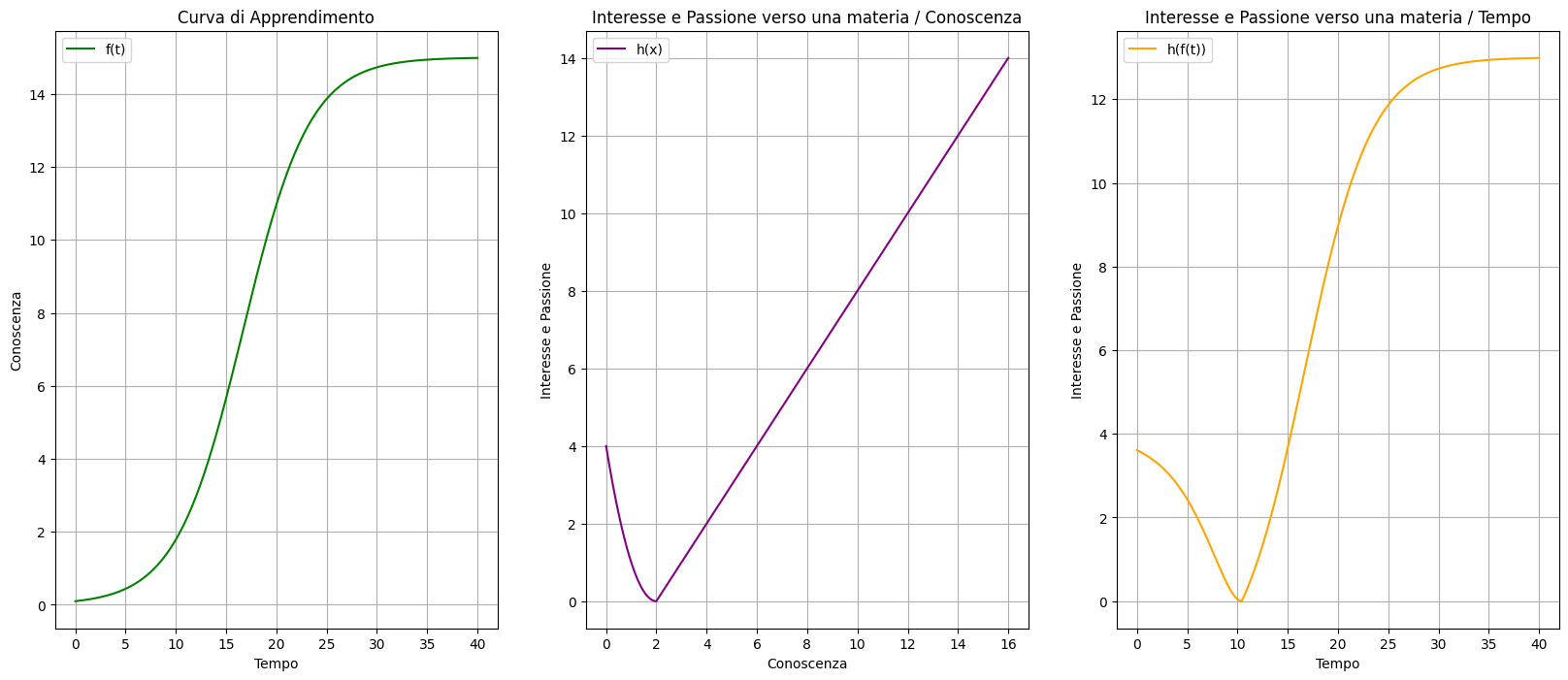
An approximate model of what I mentioned earlier
Do You Remember Ohm’s Laws?
As mentioned earlier, “winning a game” — passing an exam — requires strong problem-solving skills. And it’s precisely in this characteristic that the true educational value of engineering lies.
Most of the procedures, methods, and knowledge learned during university will turn out to be of little practical use in the workplace and will be easily forgotten. However, the methodical and analytical mindset required to analyze, break down, and solve a problem is something that stays with you — and can be applied to many other areas of life.
I find it useful to clarify this concept through two examples from my university experience.
I don’t see much practical utility in knowing in detail the characteristic curves of a DC electric motor. Yet, the mental process required to understand and draw them involves the interconnection of prior knowledge from various subjects (the basic principles of electrical engineering, the electrical model of a DC motor, the mechanical model). It also requires deductive reasoning to derive specific cases from general concepts, the ability to model and mathematically interpret a physical phenomenon, and many other logical-mathematical skills that are not tied to a single discipline but can be applied, once learned, to many other fields.
The second example comes from an area I’ve never studied systematically but have always been fascinated by: computer science (ironically, it was also the subject where I got the lowest grade of my entire academic career).
During a bachelor’s in Computer Engineering, you rarely become an expert in any specific programming language. More wisely, you’re taught general concepts, algorithms, and methodologies that can be applied in any development environment. The goal is to build a solid “mindset,” with the understanding that these concepts can be easily adapted to different professional contexts by learning the syntax of individual languages when needed.
On this note, I’d argue that the basics of computer science — fundamental algorithms, information processing, computer architecture — together with basic programming — variables and data structures, logical and arithmetic operators, control structures, functions and modularization, the concept of bugs, debugging, and testing — should be included in every high school and university curriculum. Not because the world needs more programmers, but because these subjects develop critical thinking and train mental flexibility just as much — if not more than — traditional disciplines like mathematics or Latin translation.
Memories from Start Hack 2025, the first hackathon I ever attended, and one of the most memorable, formative, and fun events of my Engineering years.
But Proofs Are Useless
Over these years in engineering, I’ve had my fair share of criticism toward the university system. Although these reflections come from a privileged position within the Politecnico di Milano, I believe they can be extended to many other Italian universities as well.
While I deeply value the more theoretical aspects of courses (even those with little practical relevance) and believe it’s more important to build a mindset than a single skill, during these three years I’ve often felt completely incapable of doing anything concrete.
In my view, it would only take a small additional effort — more credits dedicated to lab work, exams with a stronger practical component, the use of specific software during lectures, exercises, and assessments, more group projects — to develop practical skills, give tangible meaning to what’s being studied, and, more importantly, ignite greater passion among students.
I’m well aware that such a change would require greater commitment and resource investment from the university, professors, and even students themselves (who often prefer traditional exams based solely on lectures, with no labs or additional activities). However, I firmly believe that a more experience-oriented approach would lead to a tangible improvement in teaching quality and enrich the university experience in many ways.
(These reflections on expanding the educational offering seem more relevant than ever today. In an era where artificial intelligence seems capable of doing everything and knowledge itself is increasingly undervalued, I promise myself to delve deeper into this topic later on.)
How I prepared for my final exam session: a few days in Recco (GE) studying and reviewing topics together.
Exam Overfitting
Another issue I’ve noticed — closely related to the previous points and to the analogy between “game” and “exam” — is that getting a good grade, in most cases, doesn’t really correspond to having deeply understood the concepts covered in the course. As already mentioned, grades often reflect the student’s ability to learn and master the “rules of the game” rather than their actual understanding of the subject. Very often, in fact, it’s possible to achieve excellent results by studying past exams — effectively applying “overfitting” on historical data — rather than developing genuine mastery of the material.
I don’t mean to say that this evaluation system is completely ineffective or illogical — also because I’m sure that Politecnico, if it had the resources, would adopt better solutions — but I do believe it could be improved quite easily by integrating assessment methods more focused on developing practical skills, such as hands-on projects, lab activities, and group work.
Bocconi? No, Thanks.
As mentioned earlier, I believe the value of an engineering degree lies not so much in the technical skills acquired, but in the way of thinking and problem-solving approach developed over the years. That’s also why — perhaps a bit arrogantly and certainly influenced by my own experience — I’m convinced that after earning an engineering degree, one can take on almost any other discipline.
Looking back at the past three years, every time I wanted to dive deeper into a topic — not necessarily STEM-related and not strictly tied to Automation Engineering — I always felt I had the logical tools and the mathematical-scientific foundation to do so.
This doesn’t mean, of course, that everything was easy or that I always achieved the goals I set for myself. But it does mean that I never felt completely “lost” or disoriented when facing a new challenge.
Going back to my personal experience, I remember that three years ago I was torn between enrolling in Economics, Management and Computer Science at Bocconi or pursuing a more traditional and technical path at the Politecnico di Milano. Many people told me at the time: “It’s better to build a technical and engineering background first. You’ll always have time to change later on.”
Today, in that future which has now become the present, I can only agree with that advice — and be grateful for having received it.I don’t know where I’d be now if three years ago I had walked into Bocconi’s classrooms, but even though I’m certain I don’t want to design feedback systems or robots in my professional future, I’m still very satisfied — both academically and personally — with my journey at the Politecnico di Milano.